

ADHD task paralysis is a neurologically driven inability to start a task, even when you genuinely want to. It's not a character flaw or a motivation problem. The Child Mind Institute describes it as a real, common experience rooted in overlapping executive-function challenges, not laziness. If you're frozen right now, here are three things you can try in the next five minutes:
- Do one sloppy first step. Open the document. Write one bad sentence. Send one rough email. Perfection is not the goal; motion is.
- Set a 5-minute timer. Tell yourself you only have to work until it goes off. Most people keep going once they've started.
- Call or text a body double. Ask a friend, colleague, or family member to sit with you, in person or on a video call, while you work. Their presence alone lowers the activation threshold.
Pro Tip: Remind yourself: you are not stuck because you are lazy. The Attention Deficit Disorder Association (ADDA) confirms that paralysis is a symptom of executive dysfunction, a neurological difference, not a personal failure. That reframe changes everything about how you choose your next move.
Key Takeaways
ADHD task paralysis is a neurological initiation failure, not a willpower problem, and the fastest path out is a tiny, low-risk first action paired with external structure.
| Point | Details |
|---|---|
| Paralysis is neurological | Executive dysfunction and dopamine differences cause the freeze; willpower-based fixes consistently fail. |
| Know your type | Task, choice, analysis, and transition paralysis each respond to different strategies; identify yours first. |
| Activation over motivation | The 5-minute rule, first sloppy step, and body doubling lower the initiation cost rather than demanding more effort. |
| Build a personal plan | A 7-step anti-paralysis template (trigger, tactic, micro-steps, time, accountability, reward, log) outperforms generic systems. |
| Paulinaellis coaching | One-to-one neuroscience coaching translates these strategies into a lasting, personalized system for neurodivergent professionals. |
Table of Contents
- What is ADHD paralysis, and which type do you have?
- Why does your brain freeze? The neuroscience behind ADHD paralysis
- ADHD paralysis vs. procrastination: why the difference matters
- What triggers ADHD paralysis, and how does the loop work?
- Evidence-based strategies to overcome task paralysis
- What to do right now when you're completely frozen
- How to build your own anti-paralysis plan
- When should you seek professional help?
- A coaching perspective on what actually changes things
- One-to-one neuroscience coaching for ADHD paralysis
- Sources
What is ADHD paralysis, and which type do you have?
ADHD paralysis is a state where the brain's task-initiation system stalls completely. You know what you need to do. You may even feel urgency about it. But the signal that should fire to get you moving simply doesn't fire with enough force. This is distinct from ordinary procrastination, where a person delays a task they could start if they chose to. With paralysis, the choice to start feels physically unavailable.
The ADDA identifies several distinct types, and knowing which one you're dealing with changes which strategy to reach for first.
Task paralysis is the most recognized form. You sit in front of a specific task, a report, a phone call, a form, and you cannot begin. The task itself triggers the freeze, often because it feels too large, too ambiguous, or too boring to generate enough dopamine to initiate.
Choice paralysis hits when there are too many options. Deciding which project to tackle first, which email to answer, or which tool to use can loop indefinitely. The brain gets stuck comparing rather than acting.
Mental or analysis paralysis looks like overthinking. You plan, research, and mentally rehearse without ever producing output. It often co-occurs with perfectionism and can masquerade as productivity.
Transition paralysis is the difficulty shifting from one activity to another, even when the next task is something you want to do. Stopping a hyperfocus session to eat lunch, or switching from a meeting to deep work, can feel genuinely impossible.
Quick self-check: Which of these sounds most like you?
- "I know exactly what I need to do, but I can't make myself begin." (Task paralysis)
- "I can't decide where to start, so I start nothing." (Choice paralysis)
- "I keep planning and researching instead of doing." (Analysis paralysis)
- "I can't stop what I'm doing to move to the next thing." (Transition paralysis)
Most people experience more than one type, and the dominant type can shift depending on the day, the task, or the energy level.
Why does your brain freeze? The neuroscience behind ADHD paralysis
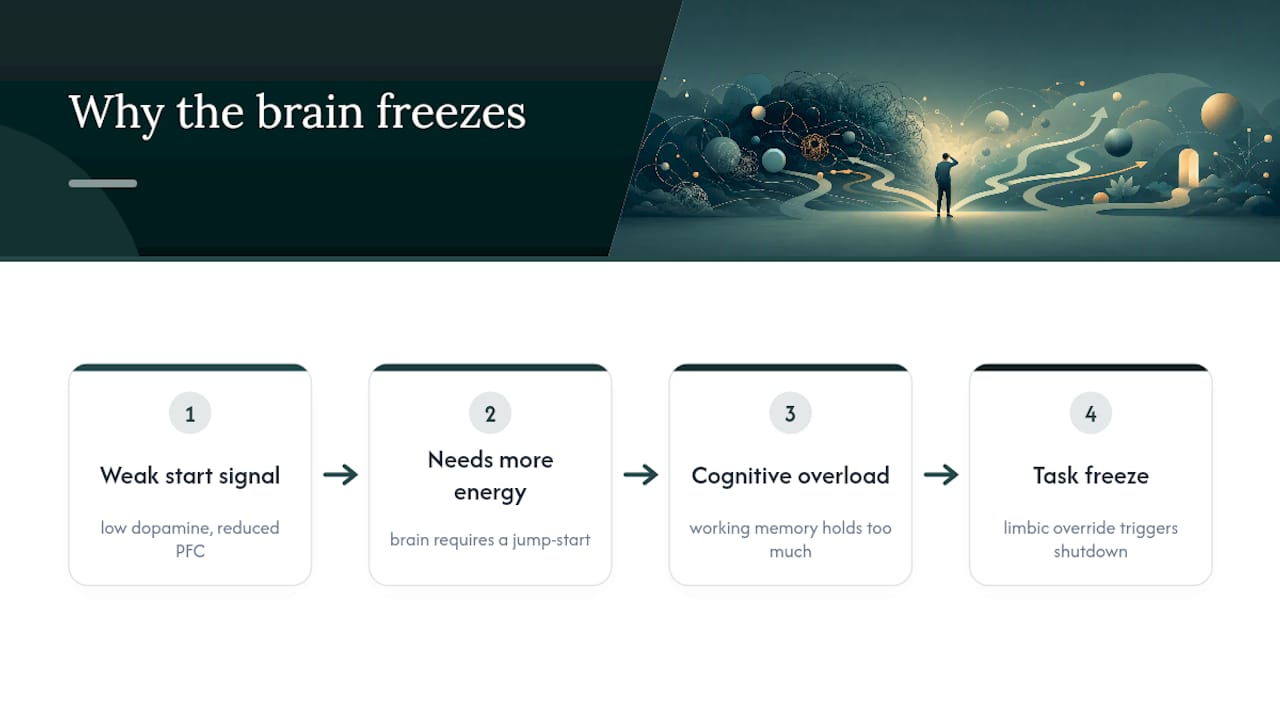
The short answer: your brain requires more activation energy to start tasks than a neurotypical brain does, and the systems that supply that energy are running on a different fuel mix.
Peer-reviewed neuroscience research links ADHD-related task initiation problems directly to differences in dopamine pathways and prefrontal cortex function. The prefrontal cortex handles planning, prioritization, and the executive command to begin. In ADHD, this region is less consistently activated, particularly for tasks that don't carry immediate reward or novelty. Dopamine, the neurotransmitter most associated with motivation and reward anticipation, is produced and regulated differently, which means the brain's internal "this is worth starting" signal is weaker or delayed.
Think of it like a car engine that needs a jump-start every single time. The car works fine once it's running. Getting it going is the problem.
Working memory adds another layer. When a task feels overwhelming, the brain tries to hold too many steps in mind simultaneously. That cognitive overload can trigger a shutdown response. Emotional intensity compounds this: if a task carries shame, fear of failure, or past associations with criticism, the limbic system can effectively override the prefrontal cortex's attempt to initiate. The result is a freeze that feels physical, because neurologically, it partly is.
Statistic callout: Research consistently shows that executive function deficits, including task initiation, are among the most functionally impairing aspects of ADHD across the lifespan, affecting work performance, relationships, and self-esteem far more than attention symptoms alone.
This is why willpower-based advice fails so reliably. "Just start" assumes the initiation system is working and simply needs a push. For ADHD brains, the initiation system itself is the problem. Strategies that work have to bypass or scaffold that system, not demand it perform on command.
ADHD paralysis vs. procrastination: why the difference matters
The distinction is not semantic. It changes which strategies actually help.
Procrastination is a deliberate, if uncomfortable, choice to delay. The person could start; they're choosing not to, usually to avoid discomfort, boredom, or anxiety. Consequences and deadlines often work as motivators because the brain can calculate the trade-off and respond.
ADHD task paralysis is a failure to initiate despite wanting to. The person is not choosing delay. They are stuck at the neurological starting gate. Consequences and deadlines can sometimes create enough urgency to trigger dopamine and break the freeze, but they can also intensify the shame spiral and deepen the shutdown.
Modern Psychiatry's clinical guide draws a clear line between these states and notes that treating paralysis like procrastination, by adding pressure or moral framing, typically makes it worse.
Here's how the three states compare:
- Procrastination: Could start, choosing not to. Responds to deadlines, accountability, and consequences.
- ADHD paralysis: Wants to start, cannot initiate. Responds to activation tactics, body doubling, micro-steps, and dopamine scaffolding.
- Depression-related shutdown: Doesn't want to start, lacks energy or interest broadly. Requires clinical evaluation; behavioral tactics alone are insufficient.
The overlap between paralysis and depression-related shutdown is real and worth taking seriously. If the freeze extends across most areas of life, persists for weeks, and comes with low mood or loss of pleasure, that's a signal to talk to a clinician rather than try another productivity hack.
Pro Tip: When you notice you're frozen, ask yourself: "Do I want to do this task?" If the answer is yes but you still can't start, that's paralysis, not procrastination. Reach for an activation tactic, not a guilt trip.
What triggers ADHD paralysis, and how does the loop work?
Paralysis rarely arrives without warning. It has predictable triggers, and once you know yours, you can often catch the spiral before it bottoms out.
Common triggers include:
- Boring or low-stimulation tasks (data entry, filing, routine admin)
- Tasks with unclear first steps or ambiguous scope
- Too many choices with no obvious priority
- Perfectionism and fear of doing it wrong
- Exhaustion or low cognitive energy, especially in the afternoon
- Emotional charge around a task (conflict, criticism, high stakes)
- Sensory overload in the environment (noise, clutter, interruptions)
- Transitions between activities, especially from high-engagement to low-engagement work
The feedback loop that follows a trigger is what makes paralysis self-reinforcing. You hit a trigger and stall. Stalling generates shame ("I should be doing this"). Shame activates the stress response, which further suppresses dopamine and prefrontal function. Lower dopamine makes initiation even harder. Avoidance feels like the only relief, which temporarily reduces the discomfort but confirms the pattern. The next time that task appears, the brain has already learned to associate it with the shame-freeze cycle.
Logging your triggers is one of the highest-leverage things you can do. For one week, note three things each time you freeze: what the task was, what you were feeling just before, and what time of day it happened. Patterns emerge quickly. Most people discover that a majority of their paralysis episodes cluster around two or three specific task types or time windows, which makes targeted planning far more effective than generic productivity advice.
Evidence-based strategies to overcome task paralysis
The most reliable approach combines tiny activation steps, external structure, and socially anchored supports. No single tactic works for everyone, but the combination of at least one activation trick, one structural support, and one external anchor covers most paralysis types.
Activation tactics
The 5-minute rule is exactly what it sounds like: commit to working on a task for only five minutes. The rule works because it lowers the psychological cost of starting to near zero. Healthline's review of ADHD procrastination strategies cites this alongside "first sloppy steps" as among the most consistently recommended evidence-based tools for task initiation.
The first sloppy step bypasses perfectionism by making the explicit goal a bad version of the first action. Write a terrible opening sentence. Send a rough draft. Make the call without preparing. ADDitude Magazine describes this as a core coaching technique: the brain's continuation momentum kicks in once motion starts, and the sloppy version almost always gets revised naturally.
Implementation intentions are "if-then" plans: "If it's 9 AM and I'm at my desk, then I will open the document and write one sentence." Research on implementation intentions shows they significantly improve follow-through on intended actions by pre-deciding the trigger and the response, removing the need for in-the-moment decision-making.
Structure tactics
Task chunking breaks a large task into micro-steps small enough that each one has a clear, unambiguous first action. "Write the report" becomes "Open a blank document," then "Write the title," then "Write one bullet for the introduction." Each micro-step is a separate task with its own activation threshold.
Externalizing means getting tasks out of your head and into a visible system. A whiteboard, a sticky note on the monitor, or a simple list app reduces working memory load and makes the task feel more concrete. The ADDA recommends externalizing as a primary strategy for reducing cognitive overwhelm.
Energy-based scheduling involves labeling tasks by the cognitive energy they require (high, medium, low) and scheduling them to match your natural energy peaks. High-focus work goes in your peak window; low-energy admin fills the afternoon slump. This prevents the common pattern of attempting demanding tasks when the brain is already depleted.
Motivation tactics
Making consequences feel present is one of the most underused strategies. ADHD brains struggle with future-oriented motivation because the reward feels too distant to generate dopamine now. The Child Mind Institute recommends implementation intentions and "why today" questions to bring the consequence of the present moment: "If I send this email now, I won't be thinking about it all weekend."
Reward swapping means pairing a task you avoid with something genuinely pleasurable: your favorite playlist, a good coffee, a comfortable location. The reward has to be immediate and tied specifically to starting, not finishing.
External supports
Body doubling is working alongside another person, in person or virtually, without necessarily talking. It works because a present person changes the brain's social-cue systems, increasing the salience of the task in real time. This is distinct from supervision or accountability; the other person doesn't need to monitor you. Their presence alone signals "time to work." ADDA's procrastination resources describe body doubling as one of the most practically effective strategies available.
Accountability partners and coaching add a layer of external structure that the ADHD brain often cannot generate internally. Knowing someone will ask about your progress makes future consequences feel more present.
Medication, when prescribed and monitored by a clinician, addresses the underlying dopamine regulation issues directly. Behavioral strategies work better with medication than without it for many people, though medication alone rarely solves the structural and habit challenges.
| Strategy | Best for | What it targets | When to use it |
|---|---|---|---|
| 5-minute rule | Task paralysis | Activation energy | Before starting any avoided task |
| First sloppy step | Analysis paralysis, perfectionism | Perfectionist barrier | When overthinking blocks output |
| Body doubling | All types | Social salience, focus | Anytime; especially for long tasks |
| Task chunking | Large or ambiguous tasks | Working memory load | During planning, not mid-freeze |
| Energy scheduling | Transition and task paralysis | Cognitive energy mismatch | Weekly planning sessions |
| Implementation intentions | Choice paralysis | Decision fatigue | When you can't decide where to start |
| Reward swapping | Low-interest tasks | Dopamine scaffolding | For recurring boring tasks |
Pro Tip: Match your strategy to your paralysis type. Choice paralysis responds best to limiting options (pick one task, set a timer). Task paralysis responds best to activation tricks (first sloppy step, body double). Analysis paralysis responds best to output-first rules ("I write for 10 minutes before I research anything").
What to do right now when you're completely frozen
These tactics are ordered by activation cost, lowest first. Start at the top.
- Stand up and move for 60 seconds. Walk to another room, do five jumping jacks, shake your hands. Physical movement shifts the nervous system state and can break a freeze faster than any cognitive strategy.
- Say the task out loud. Literally speak the first step: "I am going to open my email and reply to Sarah." Externalizing through speech engages a different neural pathway than silent thinking.
- Do one sloppy first step, right now. Open the file. Write your name at the top of the document. Dial the number. The step must be so small it feels almost embarrassing.
- Set a 5-minute timer and commit to nothing more. Not finishing. Not doing it well. Just five minutes of contact with the task.
- Text or call a body double. A two-minute call to say "I'm going to work on X for the next 20 minutes, can you check in with me after?" is often enough.
- Switch to a low-energy restorative task. If none of the above moves the needle, don't force it. Do something genuinely low-demand: organize your desk, take a short walk, drink water. Forcing a frozen brain rarely works and often deepens the shame loop.
When quick tactics are unlikely to work: if you've been frozen for more than an hour, if the freeze is accompanied by significant distress or low mood, or if this is the third or fourth consecutive day of shutdown, a quick tactic won't reach the root. That's a signal to step back, reduce demands for the rest of the day, and consider whether professional support is the right next step.
How to build your own anti-paralysis plan
A plan you build yourself, based on your actual triggers and energy patterns, will outperform any generic system. Here's a seven-step format you can copy into any note app and fill in before your next work session.
| Field | Example value |
|---|---|
| My main paralysis trigger | Ambiguous tasks with no clear first step |
| My activation tactic | First sloppy step + 5-minute timer |
| Task broken into micro-steps | Step 1: Open doc. Step 2: Write title. Step 3: Write one bullet. |
| Scheduled first-step time | Tuesday, 9:15 AM (my peak energy window) |
| Body double or accountability | Video call with a colleague at 9:10 AM |
| Short reward for starting | Favorite playlist during the session |
| Log result | Note: did I start? How long? What helped? |
Sample plan 1: Low-interest admin (expense report) Trigger: Boring, repetitive, no clear deadline pressure. Activation tactic: First sloppy step (open the spreadsheet and type one number). Micro-steps: open file, enter one receipt, enter a second receipt, repeat for 10 minutes. Scheduled time: Friday at 2 PM with a body double on video. Reward: coffee and a podcast episode immediately after.
Sample plan 2: Complex creative project (strategy document) Trigger: Analysis paralysis, perfectionism, unclear scope. Activation tactic: Output-first rule (write for 15 minutes before researching anything). Micro-steps: open blank doc, write the problem statement in one sentence, list three questions the document needs to answer, write one rough paragraph per question. Scheduled time: Monday at 10 AM, peak energy window. Accountability: share a rough draft with a trusted colleague by end of day.
Pro Tip: Run the plan for two weeks before changing anything. After two weeks, review your logs and ask one question: which step in the plan most often broke down? Fix only that step. Changing too many variables at once makes it impossible to know what's working.
ADHD-focused task design principles suggest labeling each micro-step with its energy level (high, medium, low) so you can sequence them to match your cognitive state on any given day, rather than following a fixed order that may not suit how you're actually feeling.
When should you seek professional help?
Seek professional evaluation when paralysis is frequent (several times a week), when it causes significant impact on work, finances, relationships, or safety, or when it co-occurs with persistent low mood, hopelessness, or loss of interest in things you normally enjoy. That last cluster is a signal to rule out depression, which requires clinical assessment rather than behavioral strategies alone.
What different professionals can offer:
- Psychiatrists and prescribers can evaluate whether ADHD medication is appropriate. Stimulant and non-stimulant medications address the underlying dopamine regulation issues and often make behavioral strategies significantly more effective. Modern Psychiatry's clinical overview outlines how medication and behavioral approaches work together.
- Psychologists and therapists offering CBT for ADHD can address perfectionism, shame, and the cognitive patterns that amplify paralysis. CBT adapted for executive dysfunction focuses on behavioral activation and restructuring unhelpful beliefs about productivity.
- ADHD coaches work on practical structure: building systems, accountability, and personalized plans. Coaching is not therapy and does not treat underlying conditions, but it is highly effective for translating clinical insights into daily habits.
- Peer support and body-doubling networks (such as online co-working communities) provide low-cost, high-frequency external structure that many people find as effective as formal support for day-to-day task initiation.
When searching for a clinician, describe paralysis specifically: "I know what I need to do and I want to do it, but I cannot initiate." Ask whether they have experience with adult ADHD and executive dysfunction. If you're in crisis or experiencing thoughts of self-harm alongside a shutdown, contact the 988 Suicide and Crisis Lifeline immediately.
This article provides general information, not a substitute for professional diagnosis or treatment. Confirm any clinical decisions with a qualified healthcare provider.
A coaching perspective on what actually changes things
The most common mistake I see in how people approach paralysis is treating it as a motivation problem when it's actually a design problem. The question isn't "how do I want it more?" It's "how do I make starting cost less?"
That shift sounds simple. In practice, it takes time to internalize, because most of us have spent years being told that the freeze is a character flaw. The shame that accumulates around paralysis is often more disabling than the paralysis itself. A client I worked with, a senior leader managing a complex portfolio, described spending three hours "preparing to prepare" for a single presentation, then feeling so ashamed of the lost time that the next day was worse. The paralysis wasn't the problem. The shame response to the paralysis was the problem.
What changed things was not a new productivity app or a stricter schedule. It was a two-part shift: first, understanding the neuroscience well enough to stop blaming herself, and second, building a plan small enough that starting felt genuinely low-risk. The first sloppy step became her default. Within two weeks, she was initiating tasks she'd been avoiding for months, not because she'd found more willpower, but because the activation cost had dropped below her threshold.
Progress with paralysis is rarely linear. A good week followed by a rough one is not failure; it's the normal pattern of working with a brain that responds strongly to context, energy, and emotional state. Realistic expectations matter: most people see meaningful improvement in task initiation within four to six weeks of consistent strategy use, with the biggest gains coming from identifying their two or three primary triggers and having a pre-decided response for each.
One-to-one neuroscience coaching for ADHD paralysis
Self-directed strategies work for many people. For others, the gap between knowing what to do and actually doing it consistently is exactly where a structured coaching relationship makes the difference.
Paulinaellis offers one-to-one neuroscience-based coaching built specifically for neurodivergent professionals, founders, and senior leaders who are done cycling through generic productivity systems that weren't designed for how their brains work. The focus is not motivation or mindset in the abstract. It's cognitive energy management, personalized anti-paralysis structures, and the kind of accountability that makes the plan template in this article stick beyond week two.
Coaching at Paulinaellis is available as single sessions, four-session packages, or founder-specific sprints, all delivered online. If you've read this far and recognized yourself in more than one section, that recognition is the starting point. The next step is a conversation. Paulinaellis to find out whether one-to-one coaching fits where you are right now.