

Yes, you can recover from ADHD burnout. The first thing to do right now is not rest more — it's reduce demand. Before you add anything to your day, remove something. That single shift is what separates ADHD burnout recovery from generic burnout advice, and it's where every effective plan starts.
Start here, within the next hour:
- Brain dump: Set a timer for 10 minutes and write every open loop in your head onto paper or a note app. Don't organize it. Just empty it.
- Cut one decision: Identify one recurring daily decision (what to eat, what to wear, when to start work) and pre-decide it for the next three days.
- Protect your sleep window: Pick a fixed time to stop screens tonight, even if sleep itself is disrupted. Anchor the window, not the outcome.
- Say no to one thing today: One email, one request, one commitment. Not forever. Just today.
- Tell one person: Let one trusted person know you're running low. You don't need a full explanation.
Pro Tip: Don't try to build a recovery plan while you're in burnout. Your executive function is already depleted. Use the brain dump above to offload, then return to this guide when you have 20 minutes of relative quiet.
Key Takeaways
ADHD burnout recovery requires reducing executive demand first, then rebuilding structure, then restoring capacity — in that order, not simultaneously.
| Point | Details |
|---|---|
| Reduce demand first | Before adding any recovery practice, remove at least one commitment or decision from your current load. |
| Follow the three phases | Stabilize (days 1–7), rebuild structure (weeks 2–4), then restore capacity (weeks 4–12+) at 70% output on good days. |
| Sleep is the foundation | A consistent sleep anchor is the single highest-leverage recovery action; disrupted sleep worsens all ADHD outcomes. |
| Seek professional help early | A CBT-trained therapist and an ADHD clinician for medication review are the right first contacts in Phase 1. |
| Paulinaellis coaching | One-to-one neuroscience coaching supports Phases 2–3 by building external structure, pacing habits, and accountability systems. |
Table of Contents
- What ADHD burnout recovery actually means (and how it differs from regular burnout)
- How to recognize ADHD burnout signs before they become a crisis
- Why ADHD burnout happens: the boom-bust cycle explained
- How to recover from ADHD burnout: a phased, practical plan
- How long does ADHD burnout recovery take?
- When to seek professional help for ADHD burnout
- How to prevent ADHD burnout from returning
- How neurodivergent-aware coaching supports ADHD burnout recovery
- What recovery actually looks like in practice
- Neuroscience coaching for ADHD burnout: what Paulinaellis offers
- Sources
What ADHD burnout recovery actually means (and how it differs from regular burnout)
ADHD burnout is a state of executive-capacity collapse. It goes beyond feeling tired or stressed at work. The brain's ability to initiate, regulate, shift attention, and manage emotional responses shuts down progressively, often after a sustained period of overextension, masking, or chronic overstimulation. Clinical literature describes it as involving loss of executive capacity and typically requiring longer, more structured recovery protocols than standard workplace burnout.
The World Health Organization classifies burnout as an occupational phenomenon in ICD-11, framing it as a work-related state rather than a medical diagnosis. ADHD burnout shares that occupational dimension but adds a neurological layer: the very systems responsible for managing stress, regulating effort, and recovering from overload are the ones most impaired by ADHD itself.
Here's how the three commonly confused states differ:
- ADHD burnout: Executive function collapses first. Initiation, working memory, and emotional regulation fail before mood does. Rest alone rarely restores function. Recovery requires structural change.
- Standard occupational burnout: Emotional exhaustion and cynicism dominate. Cognitive function is impaired but usually recovers with rest and reduced workload. No underlying neurological difference.
- Major depressive episode: Pervasive low mood, anhedonia, and hopelessness are central. Burnout and depression can co-occur and reinforce each other, but depression requires its own clinical treatment track.
Co-occurring anxiety and depression, which are common in adults with ADHD, complicate the picture. Anxiety tends to drive overextension (pushing through when the brain is already depleted), while depression can mask burnout recovery progress by flattening motivation even after executive function begins to return. Both modify how recovery feels and how long it takes.
How to recognize ADHD burnout signs before they become a crisis
Burnout in ADHD often looks like sudden incompetence. Tasks that were manageable last month feel impossible. The gap between what you know you should do and what you can actually do widens fast.
Emotional symptoms:
- Emotional dysregulation that feels disproportionate (crying at small frustrations, rage at minor friction)
- Numbness or emotional flatness, especially toward things you used to care about
- Shame spirals after failing to complete basic tasks
Cognitive symptoms:
- Can't start tasks you used to do easily, even ones you enjoy
- Working memory drops noticeably (forgetting mid-sentence, losing objects constantly)
- Decision fatigue hits within the first hour of the day
Physical symptoms:
- Persistent fatigue that sleep doesn't fix
- Sensory sensitivity spikes (sounds, textures, light feel unbearable)
- Frequent headaches, gut issues, or a general sense of physical heaviness
Behavioral symptoms:
- Withdrawing from people, even ones you like
- Reverting to high-dopamine escapes (scrolling, gaming, binge-watching) for hours without feeling restored
- Missing appointments, deadlines, or basic self-care tasks with no clear reason
A typical burnout arc looks like this: a professional with ADHD takes on a demanding project, masks their difficulties for weeks, hits a wall, pushes through with caffeine and adrenaline, then crashes completely. They call it laziness. It isn't.
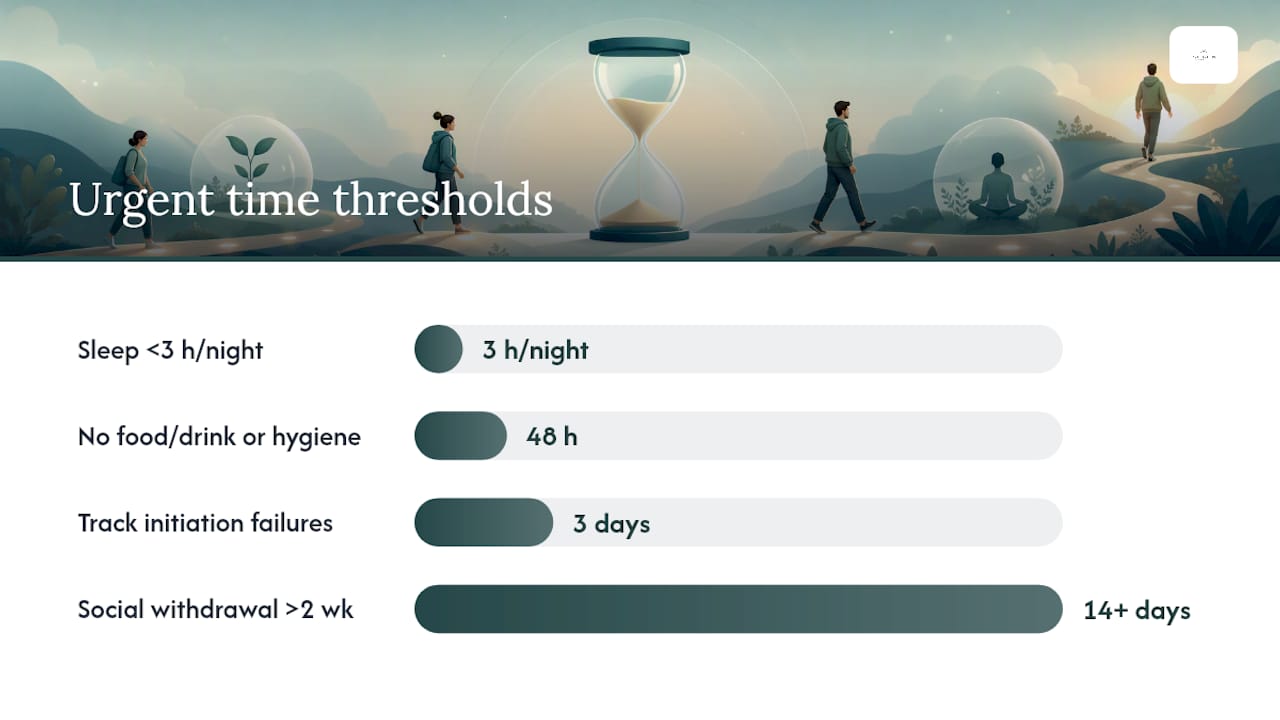
Pro Tip: Track your "initiation failures" for three days. If you can't start more than half the tasks you intend to, that's a functional signal, not a motivation problem. Write it down and bring it to a clinician.
Urgent red flags that need immediate clinical attention:
- Suicidal thoughts or self-harm urges
- Inability to eat, drink, or maintain basic hygiene for more than 48 hours
- Severe sleep disruption (less than 3 hours per night for multiple nights)
- Substance use escalating to manage symptoms
- Complete social withdrawal lasting more than two weeks
If any of these apply, contact a clinician, call 988 (Suicide and Crisis Lifeline in the US), or go to your nearest emergency room.
Why ADHD burnout happens: the boom-bust cycle explained
The boom-bust cycle is the engine of recurring ADHD burnout. It isn't random. It follows a predictable sequence that most people with ADHD recognize once they see it named.
- Build-up: A high-interest project, deadline pressure, or external accountability triggers hyperfocus. Output is high. The ADHD brain is running on urgency and novelty dopamine.
- Overload: The novelty fades or the stakes increase. Executive load climbs. Masking intensifies. The brain is compensating heavily, spending cognitive reserves it doesn't have.
- Crash: Initiation fails. Emotional regulation collapses. The person appears to "shut down" — not from laziness but from genuine neurological depletion.
- Attempted recovery: Rest is tried. Passive rest (lying on the couch, scrolling) doesn't restore executive function. The person feels guilty for not recovering "correctly."
- Relapse: Feeling slightly better, they re-enter at full demand. The cycle repeats, often faster and harder each time.
The neuroscience underneath this is specific. Chronic stress and executive-function impairment interact in ways that compound burnout pathways. In ADHD, dopamine dysregulation means the brain's reward and effort-regulation systems are already working at a disadvantage. Sustained masking and compensatory effort deplete working memory capacity and raise the metabolic cost of every cognitive task. Passive rest alone is often insufficient for ADHD burnout because it doesn't reduce the executive demand queue — it just pauses it.
The boom-bust model also explains why willpower-based advice fails. "Just push through" accelerates the crash. "Just rest" without structural change produces guilt and relapse. The only exit is a phased plan that addresses the demand load first.
How to recover from ADHD burnout: a phased, practical plan
Phased recovery that reduces demand first, then rebuilds structure, then restores capacity is the approach supported by practice-focused clinical literature. Passive rest alone is rarely enough. Here's how to sequence it.
Phase 1: Immediate stabilization (days 1–7)
The goal is to stop the bleed. Don't add anything. Remove things.
- Audit your commitments: List everything you're currently responsible for. Identify what can be delayed, delegated, or dropped for the next two weeks.
- Reduce decision load: Pre-decide meals, outfits, and work start times. Use a simple repeating template rather than making fresh choices each day.
- Protect one sleep anchor: Choose a consistent wake time and hold it, even if sleep quality is poor. Sleep disruption worsens ADHD outcomes and destabilizes recovery. This is non-optional.
- Use body doubling: Work alongside another person (in person or via video) for even 20 minutes. External scaffolding reduces the executive cost of starting tasks.
- Build a Dopamine Menu: List 8–10 low-effort activities that provide mild stimulation without high executive cost (a short walk, a specific playlist, a comfort show you've seen before). Use these instead of high-stimulation escapes that leave you more depleted. ADDA's ADHD burnout resources describe this approach in practical detail.
What to stop doing now:
- Apologizing for your output level
- Checking email first thing in the morning
- Committing to anything new for the next two weeks
- Measuring your recovery by how productive you feel
Phase 2: Rebuild low-complexity structure (weeks 2–4)
Once the acute crash stabilizes, add one anchor at a time.
- One daily anchor task: Choose a single 10–15 minute task to complete at the same time each day. Not because it's important, but because behavioral activation restores initiation momentum through small, repeatable wins.
- Boundary script for work: Use this template when declining requests: "I'm at capacity right now. I can revisit this on [specific date]." No explanation needed.
- Sensory regulation check: Identify two sensory triggers in your environment (noise, lighting, temperature) and adjust one of them. This is not a luxury. Sensory overload compounds executive depletion.
- Short daily schedule (low-demand version):
- 7:30 AM: Wake, no phone for 20 minutes
- 8:00 AM: One small anchor task (e.g., make coffee, write three sentences)
- 9:00 AM: First work block (45 minutes max, then a break)
- 12:00 PM: Lunch away from screens
- 3:00 PM: Second work block or rest
- 9:00 PM: Screen-off window begins
Phase 3: Capacity restoration and paced re-entry (weeks 4–12+)
This is where most people relapse. Feeling better, they return to full demand immediately.
- Apply the 70% rule: On good days, cap your output at 70% of what feels possible. The remaining 30% is your buffer against the next hard day.
- Medication review: If you take ADHD medication, discuss with your prescribing clinician whether your current dose and timing still fit your recovery phase. Careful titration can lower the activation energy for daily tasks and support recovery when paired with structural strategies.
- Gradual re-entry: Add one new commitment per week, not per day. Track how each addition affects your sleep and initiation the following morning.
- Weekly energy audit: Every Sunday, spend 10 minutes rating the week's energy (1–5) and identifying what drained versus restored you. Adjust the following week accordingly.
It isn't. Cap the good days deliberately.
How long does ADHD burnout recovery take?
Recovery is not linear, and the timeline varies by severity, support, and how quickly demand is reduced. That said, there are realistic ranges.
| Recovery phase | Typical timeframe | Signs you're ready to progress |
|---|---|---|
| Acute stabilization | 1–2 weeks | Sleep anchor holding; fewer emotional collapses per day |
| Low-complexity rebuild | 2 weeks | One daily anchor task completing consistently; initiation returning for simple tasks |
| Capacity restoration | 4–12 weeks | Can sustain a half-day of moderate demand; emotional regulation improving |
| Full re-entry | Several months in moderate to severe cases | Baseline function restored; pacing habits in place |
Mild burnout with early intervention can stabilize in a few weeks. Moderate to severe burnout, especially when it has been building for months or years, often takes three to six months of structured recovery before full function returns. That timeline is not a failure. It reflects the actual metabolic cost of what the brain has been doing.
Milestone checklist:
- Sleep anchor is stable for at least five consecutive days
- You can initiate one short task without a significant struggle
- Emotional dysregulation episodes are decreasing in frequency
- You can hold a conversation without feeling cognitively depleted afterward
- You've said no to at least one new commitment this week
When to seek professional help for ADHD burnout
Some parts of recovery require professional support. Knowing which professional to contact and what to ask for saves weeks of trial and error.
Provider types and what each offers:
- Psychiatrist or ADHD clinician: Medication review, diagnostic clarification, and management of co-occurring conditions (anxiety, depression). Ask specifically about your current medication's fit for your recovery phase.
- Psychologist or licensed therapist (CBT-trained): CBT adaptations for ADHD address cognitive patterns, emotional regulation, and the shame cycles that sustain burnout. This is the most evidence-supported therapy approach for adult ADHD.
- ADHD coach: External structure, implementation support, and accountability. Coaching works alongside therapy, not instead of it. It's most useful in Phases 2 and 3 when you need help building and maintaining systems.
- Primary care physician: First point of contact for physical symptoms (sleep, appetite, fatigue), referrals, and ruling out other medical contributors.
Questions to bring to your first intake appointment:
- My ADHD burnout has been building for approximately [X months]. What's the right starting point for my situation?
- Should my current medication be reviewed given my current functional level?
- What's the difference between what I'm experiencing and a depressive episode?
- What does a realistic three-month recovery plan look like for someone at my severity level?
Urgent warning signs requiring immediate evaluation:
- Suicidal ideation or self-harm
- Inability to care for basic needs (eating, hygiene) for more than 48 hours
- Severe or rapid weight change
- Substance use escalating to manage symptoms
- Complete inability to function at work or home for more than two weeks
Population health surveillance data supports using clear crisis thresholds to determine when urgent clinical care is needed rather than waiting for symptoms to resolve on their own. If you're at any of the above thresholds, don't wait for a scheduled appointment. Contact 988, your clinician's emergency line, or go to an emergency room.
How to prevent ADHD burnout from returning
Recovery without prevention is just a longer boom-bust cycle. The goal is to build systems that catch depletion early, before it becomes a crash.
Weekly energy audit (15 minutes, every Sunday):
- Rate your overall energy for the past week on a scale of 1–5.
- List the three things that drained you most.
- List the two things that restored you most.
- Identify one thing to reduce next week and one thing to protect.
- Check your commitments for the coming week and flag anything that feels like overextension.
Boundary maintenance at work:
- Request one accommodation that reduces sensory or cognitive load (noise-canceling headphones, async communication, flexible start times). You don't need a formal diagnosis disclosure to ask for reasonable adjustments.
- Use the boundary script from Phase 2 proactively, before you're already depleted.
- Schedule recovery windows into your calendar as non-negotiable blocks, not as empty time you'll fill if something comes up.
Preventative checklist for ongoing pacing:
- Apply the 70% rule on high-output days, every week, not just during recovery
- Keep your Dopamine Menu updated and accessible
- Maintain your sleep anchor even during good periods
- Do a monthly review of your commitment load (not just weekly tasks, but ongoing obligations)
- Keep one regular support touchpoint (coach, therapist, or trusted peer) even when things feel stable
- Notice the early warning signs (sensory sensitivity spiking, initiation slowing) and treat them as signals, not inconveniences
The push-crash pattern that drives ADHD burnout is not inevitable. It becomes inevitable only when pacing is treated as optional.
How neurodivergent-aware coaching supports ADHD burnout recovery
Therapy and coaching serve different functions in recovery, and understanding the difference helps you use both more effectively.
| What it addresses | Coaching | Therapy | Self-help resources |
|---|---|---|---|
| Cognitive patterns and emotional regulation | Indirectly (through structure) | Directly (CBT, DBT) | Partially |
| External structure and implementation | Core focus | Not the primary role | Partially |
| Accountability and follow-through | Core focus | Occasional | Rarely |
| Medication and diagnosis | Not in scope | Referral only | Not in scope |
| Crisis and clinical symptoms | Not in scope | Core role | Not in scope |
| Best suited for | Phases 2–3 of recovery | All phases, especially Phase 1 | Supplementary |
Neurodivergent-aware coaching, the kind grounded in neuroplasticity and ADHD-specific cognitive patterns, builds capabilities that therapy alone doesn't target:
- Designing external structures that fit your actual cognitive style, not a generic productivity template
- Building energy-budgeting habits that account for the boom-bust cycle
- Developing personalized pacing rules and accountability systems
- Recognizing your own early-warning signals and responding before they escalate
- Translating insight from therapy into daily implementation
Coaching sessions in this model are structured around your specific cognitive patterns and current recovery phase. A single session can produce a working low-demand schedule, a boundary script, and a Dopamine Menu. A multi-session programme builds the full system over time.
The ethical path: coaching is not a substitute for clinical care. If you're in acute burnout (Phase 1), start with a clinician. Once you're stabilizing, coaching accelerates the rebuild.
What recovery actually looks like in practice
The most common misconception about ADHD burnout recovery is that it looks like a steady upward line. It doesn't. It looks like two steps forward, one step back, with occasional days that feel like you've lost all progress.

One client I worked with, a founder who had been masking her ADHD for years in a high-stakes leadership role, came to coaching after a complete shutdown. She couldn't open her laptop for three weeks. The first thing we did was not build a system. We removed five commitments from her calendar and wrote a two-sentence email to her team explaining she was at reduced capacity. That was the whole first session.
Six weeks later, she had a working morning routine, a boundary script she actually used, and a clearer picture of which parts of her role genuinely fit her cognitive strengths. She wasn't "fixed." She was functioning sustainably for the first time in years.
Recovery requires structural change, not just rest. The brain doesn't unlearn the boom-bust pattern on its own. It needs new external scaffolding to replace the compensatory strategies that caused the burnout in the first place.
Neuroscience coaching for ADHD burnout: what Paulinaellis offers
Recovering from ADHD burnout is faster and more durable when you have someone who understands the neurological mechanics helping you build the right structure for your specific brain.
Paulinaellis offers one-to-one neuroscience-based coaching for neurodivergent professionals, founders, and senior leaders. The work is grounded in neuroplasticity and ADHD-specific cognitive patterns, not generic productivity advice. Three formats are available depending on where you are in recovery:
- Single session: Best for someone in Phase 2 who needs a working low-demand structure and a clear next step.
- Four-session programme: Suited for moderate burnout recovery, building a full pacing system, boundary toolkit, and energy-budgeting habit over four weeks.
- Founder sprint: Designed for founders managing high-stakes roles while recovering, focused on sustainable decision-making and cognitive energy management.
This is not therapy, and it doesn't replace clinical care. It's the implementation layer that turns insight into a system that actually holds. Paulinaellis to find the right format for your current recovery phase.
Sources
The following sources informed this guide and are worth consulting directly for deeper reading:
- Burn-out an occupational phenomenon — International Classification of Diseases (WHO)
- PMC10361779
- CDC MMWR report
This article provides general information and is not a substitute for professional medical, psychological, or psychiatric advice. If you are experiencing severe symptoms, contact a qualified clinician or call 988 (Suicide and Crisis Lifeline) for immediate support.